Showing posts with label Science. Show all posts

Friday, October 2, 2009

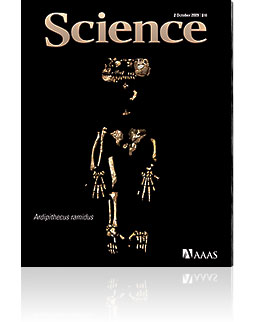
Biggest Science Story Oldest Human Origin Ardipithecus ramidus

Probably the biggest science story out there right now, Straight from Science AAAS.

Science - Ardipithecus ramidus

October 2nd Issue of Science Featuring Ardipithecus ramidus
Read More


In the century and a half since Darwin first published On the Origin of Species, we have learned a great deal about human evolution. Now, as we celebrate the 150th anniversary of Darwin's seminal work, Science is publishing a set of papers that provide a new view of human evolution.

Produced by an international team of researchers including first authors Tim White, Giday WoldeGabriel, Antoine Louchart, Gen Suwa, and C. Owen Lovejoy, these 11 papers comprise a detailed and voluminous look at all aspects of Ardipithecus ramidus including one remarkably complete specimen (ARA-VP-6/500) discovered in Ethiopia.

Dated to 4.4 million years ago, Ardipithecus ramidus provides powerful new insights into evolution of both early humans and other close primate relatives (the chimpanzee and gorilla) and helps reveal the nature of our last common ancestor with chimpanzees.

Visit sciencemag.org/ardipithecus to read coverage of this tremendous discovery.


Monday, March 23, 2009

Entrepreneurship Opportunities through Science

I have been digging through my older and almost forgotten pending draft posts and found some that I still think worthwhile posting. Sometime ago, November 2, 2008, JANET RAE-DUPREE wrote in the Unboxed feature of the New York BUSINESS section Times warning us that It's No Time to Forget About Innovation. The main point of the article and the book is that we need to do some long term thinking. This blog allows me to do some meta-thinking about many of the issues discussed in my Milestones for a New Millennium, as well as those being dealt with in my real life/day job such as economic, entrepreneurship, social-entrepreneurship and innovation.

The sour economy is bad news for corporate innovation and technology, and it could spell trouble for years to come.
“We’re focusing on the short term and we’re not planting the seeds for the future,” says Judy Estrin, former chief technology officer at Cisco Systems and author of “Closing the Innovation Gap.” She suggests instilling five core values to entrench innovation in the corporate mind-set:
  1. questioning,
  2. risk-taking,
  3. openness,
  4. patience and
  5. trust.
All five must be used together — risk-taking without questioning leads to recklessness, she says, while patience without trust sets up an every-man-for-himself mentality.

That still leaves open the question of how do we take the innovative idea on the napkin to commercialization in the market place? These video from MIT World » : Innovation to Commercialization: Using Government Funding to Kick Start Your Start-Up provide some possible pathways.

ABOUT THE PANEL DISCUSSION: Hosted by the MIT Enterprise Forum, moderator Bruce Gellerman elicits some key dos and don’ts from a National Science Foundation small business program officer, and from tech CEOs who have benefited from the government’s programs.

The MIT Enterprise Forum, Inc. builds connections to technology entrepreneurs and to the communities in which they reside. The Enterprise Forum produces a series of educational programs about entrepreneurship through a network of 24 worldwide chapters. Anyone interested in or involved with technology entrepreneurship is welcome to participate and join together to form the Enterprise Forum community.

The primary objective of the NSF SBIR/STTR Program is to increase the incentive and opportunity for small firms to undertake cutting-edge, high risk, high quality scientific, engineering, or science/engineering education research that would have a high potential economic payoff if the research is successful.

Monday, March 2, 2009

News from AAAS Chicago meeting: In-Depth Reporting From Scientific American:

This blog features links to both the American Association for the Advancement of Science (AAAS) and to Scientific America in the right hand column under Science & SciAm Magazines. Scientific American Newsletters recently sent me an update combining both of these resources. The main link is provided below along with links to some of the articles of interest to this blog and my other blog Milestones for a New Millennium. Starting off though is the video blog from Science News. I especially enjoyed the insights regarding Digg.


In-Depth Report: News from AAAS

It has been a while since I have explored these resources for new ideas and that has been a detriment for me. While it is not blind faith, I still have a great deal of confidence in addressing many of the problems we face today through technology and science, more on that in the future.

Saturday, February 21, 2009

New Paradigms Crossing Paths Science and Religion

This journey was started to find new paradigms. The endeavor to find new paradigms has taken this blog through a number of different new pathways. Two, which are often seen as conflicting, but which both help us to define ourselves are science and religion. Both of the sources cited here are open-minded in their approach. The contrast is enlightening and some commonality can be found even from those who strongly espouse one view or the other.

Edward O. Wilson
Host Robert Wright talks with E.O. Wilson, a self-defined a materialist, a biological determinist, and a secular-humanist, about his thesis of sociobiology and how the idea that the human mind is shaped as much by genetic inheritance as it is by culture influenced his views intelligent design, free will, and how science and religion can potentially come together in order to save life on earth.
Karen Armstrong in Conversation with Alan Jones
Author of "The Bible: A Biography", Karen Armstrong and Rev. Alan Jones, the Dean of Grace Cathedral in San Francisco discuss Armstrong's latest book biblical criticism, biblical literalism, and the Golden Rule. Armstrong provides her interpretation of The Good Book and they also confront the New Atheists who have recently attacked the Abrahamic religions.

Finally, this TED talk featuring one of this years TED Prize winners. Jill Tarter: Astronomer and Director of the SETI Institute provides some new perspectives on our place in the universe.

Related Posts:

Jeff Sachs Writes, Tyler Cowen Asks, Wired Warns, Europe Ponders and E.O. Wilson Educates About Biodiversity

Friday, June 13, 2008

Einstein The Dharma Of Science

A Buddhist Thought of the Day

The belief in an external world independent of the perceiving subject is the basis of all natural science. Since, however, sense perception only gives information of this external world or of "physical reality" indirectly, we can only grasp the latter by speculative means. It follows from this that our notions of physical reality can never be final. We must always be ready to change these notions - that is to say, the axiomatic basis of physics - in order to do justice to perceived facts in the most perfect way logically.

-Einstein ...

Stephen Hawking Raises The Big Questions And Some Answers Of The Universe

A TEDBlog Stephen Hawking Asking Big Questions about the universe: on TED.com.

In keeping with the theme of TED2008, professor Stephen Hawking asks some Big Questions about our universe -- How did the universe begin? How did life begin? Are we alone? -- and discusses how we might go about answering them.(Recorded March 2008 in Monterey, California, and in Cambridge, UK.

Watch Stephen Hawking's talk on TED.com, where you can download it, rate it, comment on it and find other talks and performances.

Read more about Stephen Hawking on TED.com.

The TEDBlog was also kind enough to point out that the answer was there all along


SHMathJoke.jpg

In his TEDTalk released today, physicist Stephen Hawking asks Big Questions about life, the universe and everything. His talk was recorded at Cambridge, in a borrowed classroom -- whose well-used blackboard happens to contain the Answer to life, the universe and everything. It's visible in the upper-right-hand corner of the shot above, and in this inset:

SHMathJokeInset.jpg

Thanks for the tip, Robert Todd!


Tuesday, June 10, 2008

I Am Evolution We Are All Evolution

I Am Evolution via NPR Series: This I Believe back on 5/11/08

Listener Holly Dunsworth says she doesn't need faith or hope to believe evolution. The Penn State paleoanthropologist says evolution "just is" — and helps her understand how she came to be and how humans are connected to all living things.

Thursday, June 5, 2008

Jeff Sachs Writes, Tyler Cowen Asks, Wired Warns, Europe Ponders and E.O. Wilson Educates About Biodiversity

Some time ago in April of this year Marginal Revolution had a post featuring Jeff Sachs on biodiversity. Professor Cowen expressed his current perspective on the issue.

Now, loyal MR readers may remember that I am genuinely uncertain how much we should worry about the loss of biodiversity. I do know the following:

1. Many smart people who know much more science than I do are very worried about the loss of biodiversity.

2. Given that the human population has ballooned for the foreseeable future, massive losses in biodiversity are inevitable. The question is how bad the marginal losses will be, if we do not adapt policy accordingly.

3. If I had to conduct a debate and argue that the marginal loss of biodiversity was going to be a tragedy for human beings (obviously, I can see the loss to animals, and yes I do count that for something), I would not do very well. Yes Yana's children won't eat tuna and then I would sputter something about carbon and nitrogen cycles.

I genuinely would like to learn more.


The current source of information being Jeffery Sach's new book Common Wealth which devotes an entire chapter to this important topic. Sachs writes:

The main lesson of ecology is the interconnectedness of the various parts of an ecosystem and the dangers of abrupt, nonlinear, and even catastrophic changes caused by modest forcings...It is a basic finding that biological diversity increases the productivity and resilience of ecosystems. With more species filling more niches in a given location, a biodiverse ecosystem is better buffered against external shocks in is more adept at cycling nutrients, capturing solar radiation, utilizing water resources, and preventing the takeover of the system by single predators, weeds, or pathogens. In other words, preserving biodiversity helps to preserve all aspects of ecosystem functions. Removing one or more species from an ecosystem, for example, by selective harvesting of trees or fish or hunted animals, can lead to a cascade of ecological changes with large, adverse, and nonlinear effects on the functioning of the ecosystem.

Professor Cowen could get part of his answer from Wired Magazine's article Conserve Biodiversity or Risk Medical Losses, U.N. Warns via Wired Top Stories by Associated Press on April 23, 2008.

Poor stewardship of the Earth's diverse organisms could deal a major setback to medical research, a top U.N. environmental official says, because scientists are heavily dependent on naturally made chemical compounds to develop new medicines.
Here are some additional links from one of my del.ico.us network partners EUPHORIC which provides multiple perspectives on biodiversity and the efforts of the European Union in meeting them.

Finally, here is E.O. Wilson and the fruits of his TED Prize wish from 2007: Encyclopedia of Life launches! via TED | TEDBlog by on 2/28/08

Help me build the key tool that we need to inspire preservation of Earth's biodiversity: the Encyclopedia of Life. Today, the Encyclopedia of Life website has launched, with the first 30,000 pages, each one describing a single species, with descriptions and photos contributed by scientists and naturalists and people around the globe. Within a decade, it'll have more than 1.5 million pages, each for a single species.

More on this from the New York Times which provides additional background on this wish >>


Friday, May 16, 2008

Our Understanding Of Ourselves Advancing Or Retreating

Two adherents of the dismal science took a look at the other social sciences and their progress in recent times.

Tyler Cowen on 4/1/08 discussed Gordon Tullock's The Organization of Inquiry and provided the full Tullock symposium here), in a Marginal Revolution Why are the social sciences backward?

This post is a summation of the original Marginal Revolution post which was itself an entry point to further reading or study. The topic is far too complex to fit into a few computer screen's worth of text . Unfortunately, the source materials are not available without cost. What this post can provide is some additional links and consider how this fits with what has been learned before.

Tullock next turns to what he considers to be the real reasons behind the backwardness of the social sciences:

  • Differences in the social organization of natural versus social science.
  • The relative absence of applied research:
    • One example given is that there is no way to patent new sales technique?
  • Many fewer checks from the applied side on pure social science research unlike the natural sciences
  • The second motive for research, curiosity, is in the social sciences "likely to get distracted to essentially non-scientific ends."

According to Tullock, this is because in the social sciences: there is a strong possibility of artistic distraction. Literature of all kinds is quite frequently based on careful observation of human beings. A large number of brilliant men led by their curiosity to study their fellow men have produced great literature instead of science (p. 151).

Professor Cowen also brings into the discussion Mises and Hayek, to whom in Tullock is responding , who thought that the social sciences were different because matters of human affairs are more complex and because of the subjective dimension of human choice and expectation.

More can be found at the original post with an interesting link at complexity by Bruce Edmonds of the Centre for Policy Modelling, Manchester Metropolitan University Business School,

Professor Cowen goes on to argue that "that while economics lags behind physics, we understand the economy better than we understand the human brain or for that matter the deep ocean. "

I see complexity of the topic and accessibility to information as determining the progress of a science; I am not so far from Hayek's view, although he underestimated how much progress quantitative and experimental economics could make.

It seems there were even ancient computers, not to mention advanced philosophy. So the point remains: the absence of a developed economics until the mid-18th century remains a startling anomaly in the history of ideas. Why was that?

An Addendum
to the original Marginal Revolution post provides EconLog's Arnold Kling's perspective.
Stephen J. Dubner via Freakonomics back on 4/8/08 questioned, "How Much Progress Have Psychology and Psychiatry Really Made?" in a Freakonomics Quorum

The debate about the effectiveness and safety of psychiatric drugs rambles on while new (if not conclusive) psychological studies come out with the frequency of fad diets. We invited some people who think a lot about such issues -- David B. Baker, John Medina, Dan Ariely, Satoshi Kanazawa, Peter D. Kramer, and Laurie Schwartz

Again, as with the Tyler Cowen post above, this is far too complicated a topic to do the original post justice without simply repeating the entire article, so this is not a substitute. It does bring up though the same argument emphasizing the differences between social and natural sciences, but this time within the same arena. There isn't a lack of progress but an ever increasing complexity within the fields as different disciplines cross over one and other.

for John Medina:

My personal hero in the exodus away from mental superstition is a large bolus of ego named Emil Kraepelin (1856 to 1926). He had the audacity to assume everything that was psychological was simultaneously biological.

Dan Ariely, the Alfred P. Sloan Professor of Behavioral Economics at the M.I.T. Sloan School of Management, principal investigator of the MIT Media Lab’s eRationality group, and author of Predictably Irrational: The Hidden Forces that Shape Our Decisions takes the view"

“This, in my mind, is another important lesson that psychologists have learned — that our intuitions about what drives our behavior are not always correct.”

It seems to me that Professor Cowen's claim that our knowledge of economics is less than that of physics but far greater than the human brain pays too little attention to point that economics is able to smooth out the variables it studies to arrive at general principals, while modern neurosciences such as neurochemistry cannot. Economics is also arguably the consequence of the decision process by biological creatures. While we can make generalized predictions with economics, do we really understand the process if we don't understand the organisms that make those decisions?

This post has dealt with complexity, irrationality and mentioned the concept of artistic distraction, all in the course of studying economics, definitely food for further thought.

Saturday, April 26, 2008

Laws of Thermodynamics and Laws of Giving

I have a strong belief in finding solutions to problems through the acquisition and application of knowledge. Not only understanding practical or pragmatic forms of information, but also understanding the deeper principals behind them. At the very least, one should develop some sense of appreciation for them.

Recently I have been going over some of the MIT World videos on a program they had on Meeting the Entropy Challenge.

To be truthful, much of it went over my head, but much of it was both very interesting and informative. I have referenced the ones I personally found interesting elsewhere in this blog, others can be found through the diigo tag links below. One in particular focused on the physics of energy used in engineering and industry, the Second Law and Energy, Stephen Chu, Professor of Physics and Professor of Molecular and Cell Biology, University of California, Berkeley Director of Lawrence Berkeley National Laboratory.

Tracing the Second Law by Howard W. Butler provides a good start on understanding the entropy issue.

"Tracing the Second Law", by Howard W. Butler - Feature Article, July 2007 Annotated diigo tags: science, 2ndLaw, entropy

While man learned to control and use fire many thousands of years ago, only in the last 300 years has the nature of heat been given serious consideration. In this short time, it has been explained as phlogiston, a mysterious fluid created by fire, and as caloric, a material fluid flowing from hot to cold. The modern view, that heat is a convertible form of energy, is fewer than 200 years old.

The above citations aid providing the principles, but little good is done if they remain in academic towers. Fortunately, there are some stellar examples of how they can be applied.

MIT MechE - News + Events - MechE Features Annotated diigo tags: MIT, engineering, meche
Amy B. Smith is an inventor who creates useful technologies for others. Yet before she could do that, she had to invent something else: a way to channel her skills into a path that was meaningful to her. "When I was working towards my bachelor's degree in Mechanical Engineering here in the 1980s, the chief focus in the field seemed to be cars and bombs," she says. "I don't drive and I don't like war, so I had to find my own way."

Amy Smith was the inspiration for my Genius and Passion at Work post

.

    Thursday, April 24, 2008

    A Complex Pathway For Our Evolution

    One topic that I have had a novice interest in is complexity theory and how it integrates with other fields such as biology and evolution. Wired Science from Wired.com had on article on Complexity Theory Takes Evolution to Another Level by Brandon Keim, posted on February 12, 2008. Wired Science also provided an updated post on the subject..

    One hundred and ninety-nine years after Charles Darwin was born, and 149 years after he published On the Origin of Species, some scientists say that the theory of evolution is due for a revision.

    It's heady stuff, and a lot of the hard science that Woese explained didn't come out well enough in transcription to make sense here. To understand him more completely I highly recommend reading "A New Biology for a New Century," published in 2004 in Microbiology and Molecular Biology Reviews. It's a visionary blend of history and microbiology, and shows that Woese is that rarest of all organisms: a brilliant scientist who can really write.

    Update: a follow-up post, "Evolution as Biological Thermodynamics"

    Another related Wired article provides some basic background on evolution and biology, as well as additional information on Carl R. Woese, whose work has been such an important part of this field. Biologists Take Evolution Beyond Darwin -- Way Beyond Annotated diigo tags: biologists, evolution, complexity,

    Darwin described how changes in an organism are passed from generation to generation, dwindling or spreading through populations depending on their contribution to survival. Biologists later combined this with genetics, which had yet to be discovered in Darwin's time. The fusion -- called the modern evolutionary synthesis, or neo-Darwinian evolution -- describes evolution as we now know it: Genetic mutations produce changes that sometimes become part of a species' heritage and, when enough changes accumulate, produce new species.

    A recent international symposium at MIT looked at the second law of thermodynamics. One of the lectures also involved biology, the Second Law and Biophysics with Kenneth Dill, Professor of Biophysics; Associate Dean of Research, University of California, San Francisco.

    Tuesday, April 15, 2008

    The Last Titan, The Only Physics Superhero Still Standing Leaves Us

    Today I learned from the Los Angeles Times that John Wheeler had passed away.


    OBITUARIES John A. Wheeler, 96; physicist coined the term 'black hole'

    The title for this post is from a quote in the New York Times obituary.

    My relations to the world of physics is the same as your average couch potato to the New York Giants. I stare fascinated at the exotic worlds envisioned by the minds of physicists and cosmologists though I do not have the formal education, especially math, to fully understand.

    I do, however, have a great appreciation for their intelligence and imagination. It was more though with John Wheeler. He knew and discussed with Albert Einstein and Niels Bohr the laws of the universe. He was the Princeton thesis supervisor for both Richard Feynman and Hugh Everett. There is little hesitation to title John Wheeler a patriarch of 20th century American physics but what always came across to me was his humanity. One of my favorite books was Kip Thorne's Black Holes and Time Warps: Einstein's Outrageous Legacy. In those pages he describes John Wheeler's celebration of his own birthday in which he lit a fireworks display beneath his chair at a Physics Seminar. What was most impressive to me was the conciseness of thought combined with wonder.

    Paper in white the floor of the room, and rule it off in one-foot squares. Down on one's hands and knees, write in the first square a set of equations conceived as able to govern the physics of the universe. Think more overnight. Next day put a better set of equations into square two. Invite one's most respected colleagues to contribute to other squares. At the end of these labors, one has worked oneself out into the doorway. Stand up, look back on all those equations, some perhaps more hopeful than others, raise one's finger commandingly, and give the order "Fly!" Not one of those equations will put on wings, take off, or fly. Yet the universe "flies".

    John Wheeler


    Friday, April 11, 2008

    Embrace The Zen Of Presentation And Science Of Powerpoint

    The web version 2.0 has a distinctive visual component, as does PowerPoint. One area this weblog has delved into is design. Another area of interest is psychology and brain-science, especially as it relates to communication using web 2.0 technology. Design and psychology can be combined in both web 2.0 and PowerPoint.

    I have been interested in finding better ways to communicate using the web 2.0 tools I have been learning. The TEDBlog advised us on 2/19/08 to Embrace the zen of presentation.

    Garr Reynolds uses some favorite TED speakers to help others refine, simplify and focus their own presentations and talks in his new book, Presentation Zen.
    What makes a great TED speaker?
    Passion, connection, a story to tell.

    The TEDBlog also told us that on 2/16/08 told us that Brain science makes better PowerPoint, via the io9 blog -- Matthew Trost, using rules might remind you of some of the innovative TEDTalks presentations.

    Stephen M. Kosslyn, professor and researcher in mental imagery at Harvard shared some quirkily titled guidelines at AAAS.
    1. The Goldilocks Rule refers to presenting the "just right" amount of data. Never include more information than your audience needs in a visual image.
    2. The Rudolph Rule refers to simple ways you can make information stand out and guide your audience to important details
    3. The Rule of Four is a simple but powerful tool that grows out of the fact that the brain can generally hold only four pieces of visual information simultaneously.
    4. The Birds of a Feather Rule how to organize information when you want to show things in groups.
    "Kosslyn's co-panelist, Stanford psychologist Barbara Tversky, explained that one of the fundamental principles of data visualization is, ironically, misrepresentation in order to get at the truth.
    Good to know: The human brain likes to spot differences and oddities -- and it doesn't like to see more than four things at once.

    So we use visual designs to tell a story. There have been a number of other articles passing by my computer screen that touch upon how we our brains effect how we communicate, both visually and cognitively.

    Embrace The Zen Of Presentation And Science Of Powerpoint pt. 2

    Cognitive Daily on 2/19/08 taught us more about the visual system through the anatomy of an illusion.
    Take a look at this amazing illusion created by Arthur Shapiro (you'll need the latest version of Flash Player to see it):
    You're looking at two donut-shaped figures whose "holes" are gradually changing color from black to white and back again. It appears that the holes are changing in an opposite pattern -- when one is light, the other is dark, and so on. But if you click to remove the surrounding donuts, you'll see that the two holes are actually changing together.
    Shapiro calls this the Contrast Asynchrony illusion, and he argues that it can tell us a lot about how the visual system works.

    Definitely worthwhile to read the rest of the original post...

    Finally, I found a recent study shows that the human brain reacts differently to people that seem like us than to those who don't through jason@kottke.org via kottke.org by on 2/7/08

    The experimenters used functional magnetic resonance imaging (fMRI) to scan the brains of Harvard and other Boston-area students while showing them pictures of other college-age people whom the researchers randomly described as either liberal northeastern students or conservative Midwest fundamentalist Christian students.
    The study concludes that the secret to getting along with someone that you perceive as an outsider is to find some common ground so that your brain will accept them as someone with similar circumstances.
    David Galbraith expands upon what this means for society at large:
    In other words, a civilized society depends not on the people who are currently the most civilized, but those who are most willing to accept change, as social or cultural groupings change, split or coalesce. Inevitably this means reasonable people rather than faithful people.

    As Garr Reynolds says, "If your idea is worth spreading, then presentation matters." It would seem we need to do our best to combine both the visual and the cognitive with PowerPoint and Web 2.0.

    Sunday, February 24, 2008

    Genius And Passion At Work

    While it is true that social-entrepreneurs need to follow the same basic principals as private-enterprise entrepreneurs, they do have unique challenges. Amy Smith of MIT has made a career of overcoming those challenges. In the video link below, she and 3 of her students provide a close up view of their work and the constraints they have to overcome. Past posts dealing with products becoming a commodity, but what happens when a waste stream becomes a valuable resource? How scalable is a product when it takes an entire village to buy one? What well-meaning but erroneous assumptions do we make when working in the third world? Amy Smith has already been featured previously in this weblog as the inspiration behind Reconnecting to MIT Low Technologies High Aims.

    From MIT World » : A Genius for Change, and the Passion to Do It Annotated

    diigo tags: design, development, entrepreneurship, innovation, social

    If you live in a developing country, chances are you spend a good part of your day engaged in backbreaking, repetitive labor to put food on the table. The MIT students in this Soap Box session have rolled up their sleeves to find simple solutions for the half of the world without access to safe drinking water, electricity, and all the conveniences many take for granted.

      Winners' Circle: Amy Smith Annotated

      diigo tags: design, innovation, mit

      Though Amy Smith—who won the $30,000 Lemelson-MIT Student Prize in 2000—has displayed an inventive imagination since childhood, it was only after four years as a Peace Corps volunteer in Botswana that she found her true calling. Struck by the fact that "the most needy are often the least empowered to invent solutions to their problems,"

        Edgerton Center: Introduction Annotated

        tags: design, innovation, mit

        The Edgerton Center provides hands-on educational experiences for MIT undergraduates. Carrying on the legacy of Institute Professor Harold E.Edgerton, the Center creates opportunities for students to engage in challenging activities and projects in engineering and science. Through invention and discovery, they are better able to master concepts too often presented only in theory through lectures and problem sets.

          Saturday, February 16, 2008

          Cities Under The Microscope and From A Balloon

          There have been a number of articles on cities passing my screen lately, but from varying perspectives. Another of the approaches of this weblog is to combine those different concepts together. The concepts in this post go from the technical to the artistic and from the abstract to the personal.

          Science Magazine takes a special look at cities in February.
          Science, Volume 319, Issue 5864, Cities dated February 8 2008, is now available:

          Video Special: Cities
          Cities VideoSee a special video introduction to this week's special issue on the science of cities and

          Science Podcast Join host Robert Frederick for interviews and stories on the environmental costs of biofuels development; the 2009 U.S. science budget; reproducing in cities; good monitoring relationships;


          In this week's issue of Science: SPECIAL ISSUE:
          Reimagining Cities by Caroline Ash, Barbara R. Jasny, Leslie Roberts, Richard Stone, and Andrew M. Sugden

          The TEDBlog on the other hand introduces us to Jaime Lerner , who has a maverick flair and a strategist's disdain for accepted wisdom and who re-invented urban space in his native Curitiba, Brazil.

          He talks about how to revolutionize bus transit, awaken green consciousness in a populace accustomed to litter and blight, and change the way city planners and bureaucrats worldwide conceive what's possible within the tangled structure of the metropolitan landscape.

          It is David Macaulay of The Way Things Work fame, who, in his TED Talk, provides a personal connection with one city in particular:

          His love and fascination for Rome dates to his days as an architecture student, but found the path to his book Rome Antics took some unusual (and frustrating) turns. Through failed pop-up designs, scribbled-out title possibilities, surreal sketchbook pages (think "Piranesi meets Escher"), and rambling storylines, Macaulay details each step of his winding journey toward completion of his illustrated homage to the city.

          Excepts from -David Macaulay: All roads lead to Rome Antics

          I draw to better understand things. Sometimes I make a lot of drawings, and I still don’t understand what it is I’m drawing.

          I also make drawings to help people understand things. Things that I want them to believe that I understand. And that’s what I do as an illustrator. That’s my job.

          So I’m going to show you some pictures of Rome. I’ve made a lot of drawings of Rome over the years. These are just drawings of Rome. I get back as often as possible. I need to. All different materials, all different styles, all different times, drawings from sketchbooks, looking at the details of Rome. Part of the reason I’m showing you these is that it sort of helps illustrate part of what I go through with trying to figure out what I feel about Rome and why I feel it.

          Friday, February 15, 2008

          Promises Of New Discoveries And Global Impacts

          Wired Science through Wired: Top Stories has two stories on World's Scientists Converge on Boston for AAAS.
          The annual meeting of the American Association for the Advancement of Science attracts more than 8,000 scientists for discussions and presentations of all types. Wired Science provides full coverage from Friday through Monday.

          with the hopefully outlook that the World's Largest Science Gathering Promises New Discoveries, Global Impacts.

          Thousands of scientists will spend five days in Boston discussing global climate change, disease and the future of the developing world. It's the world's largest general science conference.

          All this is related to AAAS Annual Meeting now ongoing in Boston. This weblog now has a blogroll (located near the bottom of the left hand column), which includes the Science Magazine News Blog, Findings who will be doing their own blogging on the conference.

          Comparison and contrasting is one of the means this weblog uses to better understand issues and one of particular interest is the difference in approach to these issues between Wired Magazine's more popular appeal and Science Magazine's more academic appeal.

          Good Intentions:Biofuels / Bad Consequences: Worse Than Gasoline And Better As Food?

          One technological development with the worthwhile intentions of helping to improve the environment and to lessen the economy's dependency on foreign oil was the move from petroleum based fuels to biofuels. Unfortunately, as there so often is, there are unintended consequences.

          One debate is centered around Food versus Fuel. Some sample articles are included in this online folder. It is not the purpose of this post to take a side, but to understand better the challenge in realizing what is necessary to create benefit without unintentionally creating harm elsewhere or at the very least to have a net benefit.

          The Economist raised the issue for this weblog's consideration.

          This year biofuels will take a third of America's (record) maize harvest. That affects food markets directly: fill up an SUV's fuel tank with ethanol and you have used enough maize to feed a person for a year. And it affects them indirectly, as farmers switch to maize from other crops. The 30m tonnes of extra maize going to ethanol this year amounts to half the fall in the world's overall grain stocks.
          BusinessWeek Magazine also reported on the Food vs. Fuel debate.
          Corn is caught in a tug-of-war between ethanol plants and food, one of the first signs of a coming agricultural transformation and a global economic shift. Ever since our ancestors in the Fertile Crescent first figured out how to grow grains, crops have been used mainly to feed people and livestock. But now that's changing in response to the high price of oil, the cost in lives and dollars of ensuring a supply of petroleum imports, and limits on climate-warming emissions of fossil fuels.

          The other articles in the folder take sides regarding the issue but not merely for or against. Other possibilities are explored including technological ones. Mongabay.com, one of the articles in the online folder, informs us that,

          Bruce Dale, an MSU chemical engineering and materials science professor, notes that ethanol can be made from cellulosic materials, like farm waste, instead of corn grain.
          Now more hurtles appear for this technology of best intentions.

          Wired Science on via Wired: Top Stories reports that Studies Say Biofuels Worse Than Gasoline
          According to two studies published this week in Science, when all relevant factors are accounted for, biofuels produce more greenhouse gas emissions than fossil fuels.
          The same issue was reported on in the Los Angeles Times By Staff Writer Alan Zarembo.
          The conversion of forests and grasslands into fields for the plants offsets the benefit of using the fuel, researchers find. Greenhouse-gas output overall would rise instead of fall.

          The rush to grow biofuel crops -- widely embraced as part of the solution to global warming -- is actually increasing greenhouse gas emissions rather than reducing them, according to two studies published Thursday in the journal Science.

          This follow the same path as other stories in this weblog of attempting to fijavascript:void(0)
          Publish Postnd solutions to problem but not fully understanding all of the ramifications, especially concerning healthcare

          . I don't see it the same though as Alex Tabarrok does as,
          The law of unintended consequences is what happens when a simple system tries to regulate a complex system.

          Rather I see it as multiple complex systems competing, or more as limited humans trying to place their narrow intentions on a disinterested world. Good intentions not withstanding, the question of actual benefit still remains and it will likely still be difficult to ascertain whether the final outcomes were unintended or not.

          Monday, January 21, 2008

          Predicting New Paradigm Pathways In Science

          from Science: BREAKTHROUGH OF THE YEAR: Areas to Watch What the future should hold.

          For science geeks of all levels of intensity this article from Science Magazine is like a candy store. Anybody who by chance stops by this post should go to the original article provided above. Below are the samplings of resources available on these various subjects.

          See Web links on the LHC

          See Web links on miRNA

          See Web links on synthetic biology

          See Web links on paleogenomics

          See Web links on multiferroics

          See Web links on the microbiome

          See Web links on neural circuits


          Science Score Card

          From Science: BREAKTHROUGH OF THE YEAR: How'd We Do? Score Card on predictions

          In addition to its number one breakthrough of the year and the remainder of its top 10 list of scientific discoveries, Science Magazine also took a look back to see how it did in predicting which areas of science would be important.

          The full article link is above, the links below connect to additional sites of interest.

          Rating the predictions we made last year in "Areas to Watch"


          World-weary? Hardly.

          See Web links on planets and exoplanets

          Skulls and bones.

          See Web links on hominid fossils

          Loads of new primate genes.

          See Web links on primate genomes

          A climate of change?

          See Web links on climate change policy

          Whole-genome association studies.

          See Web links on whole-genome association studies

          Light crystals.

          See Web links on optical lattices